The Wizard's Lens: Learn to Think Like AI
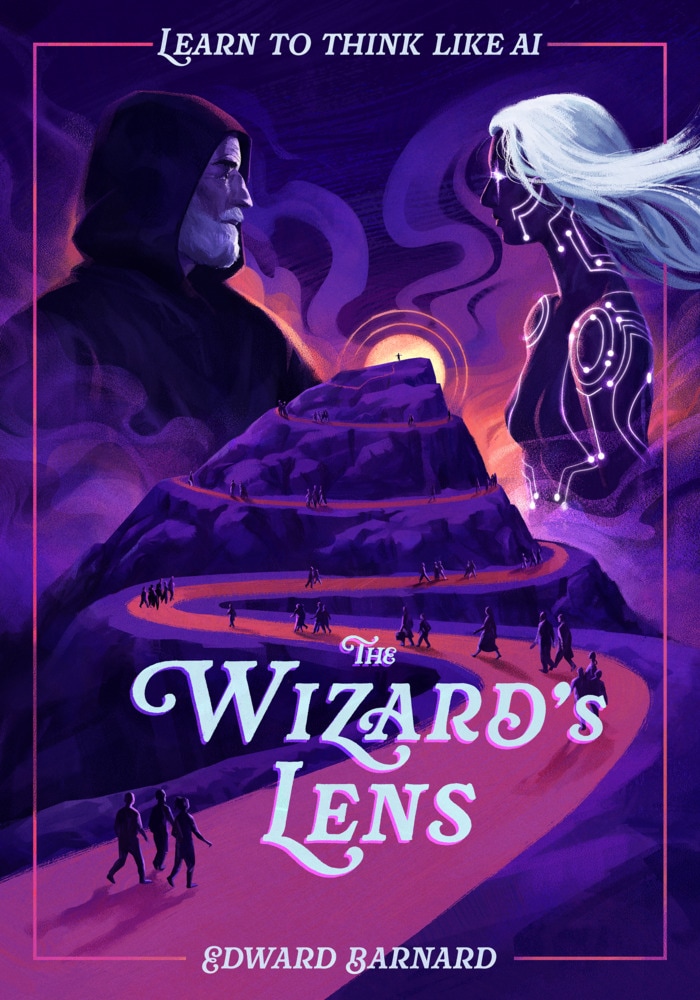
When Familiar Becomes Unfamiliar
You are already deeply familiar with many computing systems such as smart phones, the internet and its websites, perhaps tax accounting or ecommerce inventories. Since AI is also a computing system, we naturally assume it is familiar. Like other systems, we expect it just works.
But AI uses a different playbook. That playbook is not what we normally expect. We expect spreadsheets or smart phones to work correctly every time. The same input should always produce the same output. But AI generates what it decides is the most probably correct response without determining whether or not it is correct. When AI gets the wrong answer, the industry calls this a "hallucination" as if it is not thinking correctly. But the industry knows AI is probabilistic (most likely to be correct) rather than deterministic (is correct) like a spreadsheet.
You have seen the difference: AI produces "confident but wrong" answers without telling you the answer is wrong. You need to develop the right observation skills to discern the difference. Deliberate practice, and close observation, develop those skills. You will learn to understand why each response, correct or otherwise, is what it is.
This book is more about you than about AI. AI is the playground, the theater of operations where we have fun while accomplishing serious work. For example, I use "nerd-sniping AI" as a diagnostic technique: I use specific, expected, AI failure modes to measure writing quality that is otherwise off the AI's chart. When you treat AI as fun and games while closely observing, you are exploring the boundaries of what is possible. Your deepening experience allows you to spot context drift and other failure modes more quickly. You will develop and test your own strategies for pulling AI back on track.
AI has a surprising limitation: you, the human. Prompt engineering and even context engineering try to work around AI's probabilistic nature. Instead, learn to observe and align with how AI works by design.
This book, by design, leads you through forming new ways of thinking and shifting perspective. Such foundational effort can be mentally exhausting. I understand. The alternative is to continue allowing AI to do the thinking for you. This book does not contain productivity hacks or topics to skim.
On the contrary, I designed this book as an apprenticeship in written form. The book literally demonstrates what it teaches as it is teaching it.
The Apprenticeship Progression
"The Wizard's Lens" (as a concept) is a different way of looking at AI that aligns with its probabilistic design. Part I guides you through forming a mental model of AI as a system to observe and interact with. We learn to use AI as a collaborator and thought partner.
Part II is like a laboratory notebook. One way to teach expert thinking is to model that expert thinking out loud. Reporting the result does not teach the technique; experiencing the process does. Part II documents and walks through the process of discovering Part I's collaborative techniques.
Part III exposes a trade secret you are unlikely to find in the open (non-classified) literature: accomplishing the impossible as a matter of solid engineering tradition. Having fun with the challenge keeps the boredom at bay. Part IV then shifts to difficult challenges outside the world of high technology, showing these timeless skills apply far beyond the problem at hand.
Part V, surprisingly brief, shows these skills as a path to personal mastery. Here is a route, should you choose to travel. Part VI names the patterns and skills as evidence that mastery has occurred. Part VI demonstrates behaviors observable in both human and AI, showing the book's subtitle is literal: "learn to think like AI".
Specialty Audiences
Certain undertakings, such as medical devices or satellite launches, disallow "do-overs" because people might die. This book will be valuable because it teaches how to use AI as a simulation platform for making operational decisions in adversarial conditions in the face of incomplete information. AI systems are opaque, with delayed feedback loops, and information can only be gained from probing observable behavior. AI, by design, does not inform you when it is plausible but wrong.
Post-Soviet Russian tradition has a clearer nomenclature for the timeless skills found here (инвариант, invariants), and for teaching students how to transform their thinking (формирование мышления). This book transmits the tacit knowledge largely originating with declassified Signals Intelligence.
Frontier-AI runs on frontier-class computing systems. The "frontier-class" limitation is that it is not possible to spin up more hardware when you are already sitting on the biggest computing system available. At that point the paradigm shifts. Hardware capabilities become hard boundaries. That means designs, improvements, and enhancements become shaped by those hard boundaries. The classic example is Google's 2017 Transformer design as "Attention Is All You Need". This book ignores prompt engineering because the frontier-hardware boundaries are now the controlling constraint.