Books
The AI Coverup: Have We Been Hallucinating?

Claude Opus 4.7 fails on this book's seven-word title. The industry calls this hallucination. It isn't. AI tools are probabilistic systems sitting on top of constraints that everyday abstractions cover up, and the engineering tradition that knows how to work at that frontier traces back through Cray Research to the Bletchley Park codebreakers. This is Book 1 of a three-book written apprenticeship in world-class computing tradecraft.
Nobody but Us: A History of Cray Research's Software and the Building of the World's Fastest Supercomputer

We build the world's fastest computers. Period. That was our unofficial Cray Research motto, and the tradecraft behind it was never written down. It is Top Secret in origin and tacit by transmission, passed person to person from the Bletchley Park codebreakers through ERA and CDC to Cray. Frontier-class AI is now hitting the same constraint Cray Research lived inside for decades: you cannot spin up more hardware when you are already sitting on the largest system available. Volume 2 is the history, the patterns, and our way of thinking.
The Wizard's Lens: Learn to Think Like AI

I use "nerd-sniping AI" as diagnostic signal, what the industry calls "hallucinating." That name hides the design: AI is probabilistic, generating what is most likely to be correct without knowing whether it actually is. The Wizard's Lens is our close-observation tradecraft that aligns with how AI works by design, developed through deliberate practice, with AI itself as the playground. Volume 3 of the HPC Tradecraft Apprenticeship.
Through the Eye of the Eagle: Finding the Path to Soviet Supercomputing
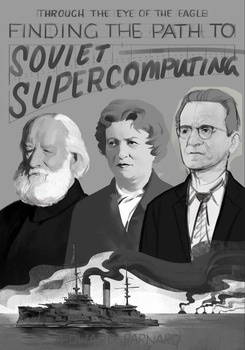
This fourth apprenticeship volume opens with the battleship Orel still afloat at the Battle of Tsushima, kept upright by Alexei Krylov's mathematics of unsinkability, and follows that same insistence on physical consequence into the heart of Soviet supercomputing. Working from Russian-language primary sources and reproducing the calculations by hand, it traces one invariant (how numerical error really accumulates) from Krylov's 1906 lectures to Glushkov and Yushchenko's Kiev computer, and shows it surfacing in the West in 2019. Along the way it examines an "overcoming the barrier" technique behind the Kiev machine's hardware loops and asks what a computing culture achieves when it invests in people rather than hardware. This book earns a place in the apprenticeship series by being a fable for our times, told entirely through worked examples.